
Dubai's private-sector Agentic AI push is now a market readiness test
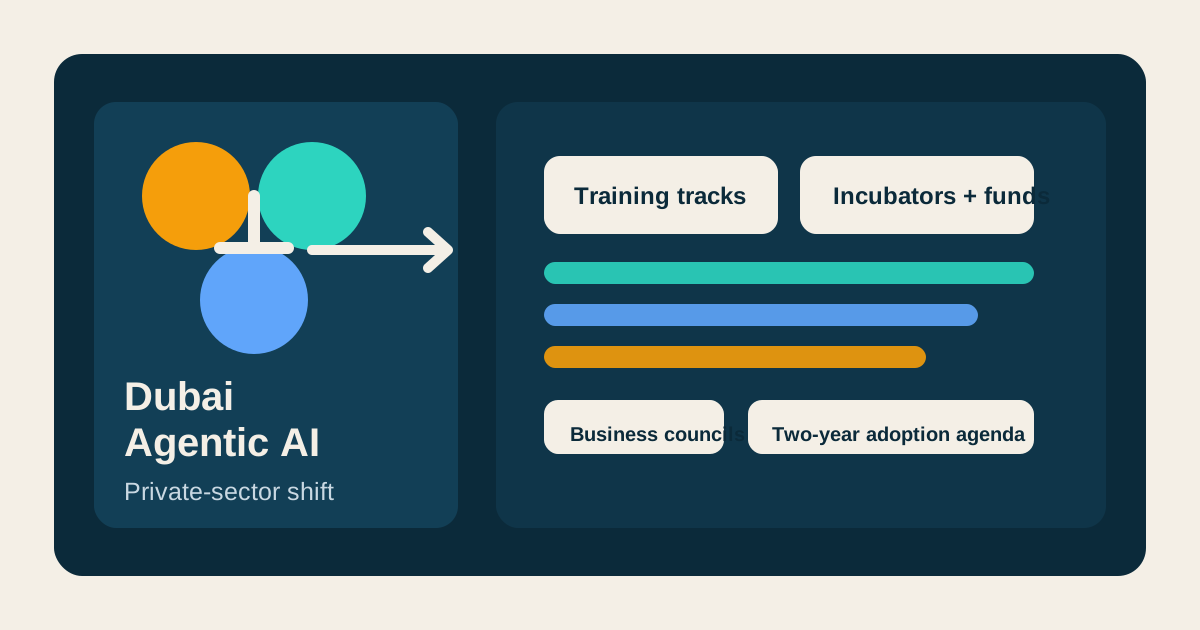
Dubai's 4 May 2026 private-sector Agentic AI initiative turns AI adoption into a two-year business agenda built around training, incubators, and funding, raising the bar for companies that want to stay competitive in the UAE market.
Dubai's newest AI signal is not only coming from government departments. It is now being pushed directly into the business ecosystem.
On 4 May 2026, Sheikh Hamdan bin Mohammed launched a new initiative to transition Dubai's private sector toward Agentic AI within two years. According to the Government of Dubai Media Office, the programme includes specialised training tracks for all business councils affiliated with the Dubai Chamber of Commerce, as well as plans for incubators for Agentic AI companies and dedicated funds to support the shift.
That matters because it reframes AI adoption as a competitiveness issue for companies in Dubai, not just a public-sector modernisation story.
The direct answer
Dubai's private-sector Agentic AI initiative matters because it connects AI adoption to three practical levers at once:
- business training
- company formation and incubation
- capital support for new AI ventures
For professionals, founders, enterprise leaders, and business teams, the message is clear: the market is moving beyond tool experimentation and toward operational adoption, ecosystem building, and workforce readiness.
What Dubai actually announced
The official announcement is specific enough to be useful.
Dubai said the programme aims to transition the private sector toward self-executing and self-leading AI over a two-year period. The announcement also said:
- specialised training tracks will be introduced for business councils under the Dubai Chamber of Commerce
- the Chamber has been directed to establish incubators for Agentic AI companies
- dedicated funds will be set up to support this shift
- the goal is to help companies boost productivity, expand business volumes, and develop future-ready business models
This is important because many AI announcements talk about innovation in broad terms. Dubai tied this one to business institutions, support infrastructure, and a defined time horizon.
Why this is different from a normal AI adoption story
Most AI market stories fall into one of two categories: a company buys AI software, or a government publishes an AI strategy. This initiative sits in a more consequential middle ground.
It tries to shape private-sector behavior at ecosystem level.
That means Dubai is not only encouraging firms to use AI. It is trying to create the conditions for adoption through training channels, startup support, and funding pathways. That is a stronger market signal than a standalone product rollout because it affects:
- established companies that need workflow redesign
- founders who want to build Agentic AI products in Dubai
- young professionals who need commercially relevant AI skills
- service providers who will be expected to implement AI with more discipline
Why the training angle matters
The training component is one of the most practical parts of the announcement.
Business councils are where sector relationships, trade communities, and business decision-makers already gather. If specialised Agentic AI training is routed through that structure, AI capability-building becomes much closer to real operating contexts instead of generic awareness sessions.
For AiRK's audience, that matters a lot. The valuable learner in this environment is not the person who only knows prompting basics. It is the person who can:
- map a workflow before automating it
- identify where an AI agent can act and where a human must review
- define approval rules and escalation steps
- evaluate whether the underlying data and systems are usable
- translate AI tools into measurable business outcomes
That is a higher bar than first-wave generative AI literacy, but it is also where more of the value will be created.
Why incubators and funding change the story
The incubator and funding pieces suggest Dubai wants this shift to create supply, not only demand.
That matters because companies adopting Agentic AI will need more than access to global software vendors. They will also need local implementation partners, sector-specific tools, and startups that understand the UAE operating environment.
Dubai already has some of the underlying infrastructure for that. In January 2026, Dubai Chamber of Digital Economy said it had supported the establishment and expansion of 1,690 digital startups during 2025, with AI companies making up around 15% of the total. In April 2026, Dubai Founders HQ said its first accelerator wave produced 36 proof-of-concept opportunities, with 15 in advanced due diligence or contracting and 3 signed agreements during the programme cycle.
Those numbers do not prove the Agentic AI initiative will automatically succeed. But they do suggest Dubai is building on an ecosystem that is already producing startup formation, accelerator activity, and faster commercial pathways.
What enterprises should take from this now
Large and mid-sized companies in the UAE should not read this as a call to automate everything quickly. They should read it as a prompt to become more structured.
A practical response would be:
- Choose one or two high-friction workflows where repetitive knowledge work already exists.
- Define what an AI agent could do inside that workflow and where human sign-off must remain.
- Train the actual team that owns the process, not only the innovation team.
- Measure productivity, error rates, handoff quality, and user trust before scaling wider.
The companies that move well here will probably be the ones that combine process clarity, role-based training, and governance discipline.
What founders and young professionals should watch
For founders, the message is that Dubai is signaling demand for applied Agentic AI, especially products that can improve productivity, reduce cost, and fit real commercial workflows.
For young professionals, the opportunity is not only to "learn AI." It is to become useful inside AI-enabled business operations. Skills that are likely to matter more include:
- workflow automation design
- AI operations and supervision
- data handling and governance awareness
- prompt and task design for multi-step systems
- business process improvement with measurable outputs
That combination is more commercially valuable than superficial tool familiarity.
AiRK view for the UAE market
Dubai's private-sector Agentic AI initiative is one of the clearer UAE market signals of the month because it pushes AI out of the lab and into business readiness.
The most important part is not the phrase "Agentic AI" itself. It is the operating implication behind it: companies will increasingly be judged on whether they can train teams, redesign workflows, and adopt AI with enough control to create repeatable business value.
For AiRK's audience, the practical takeaway is simple. This is the right moment to move from AI awareness into AI operating competence.
Sources
- Government of Dubai Media Office: Hamdan bin Mohammed launches new initiative to transition Dubai’s private sector toward Agentic AI within two years
- Government of Dubai Media Office: Dubai Chamber of Digital Economy supported the establishment and expansion of 1,690 digital startups during 2025
- Government of Dubai Media Office: Dubai Founders HQ and Plug and Play accelerate tangible commercial pathways between startups and corporates
- Government of Dubai Media Office: Dubai Holding to deliver first enterprise-scale AI deployment of its kind in the Middle East and Africa supported by Microsoft